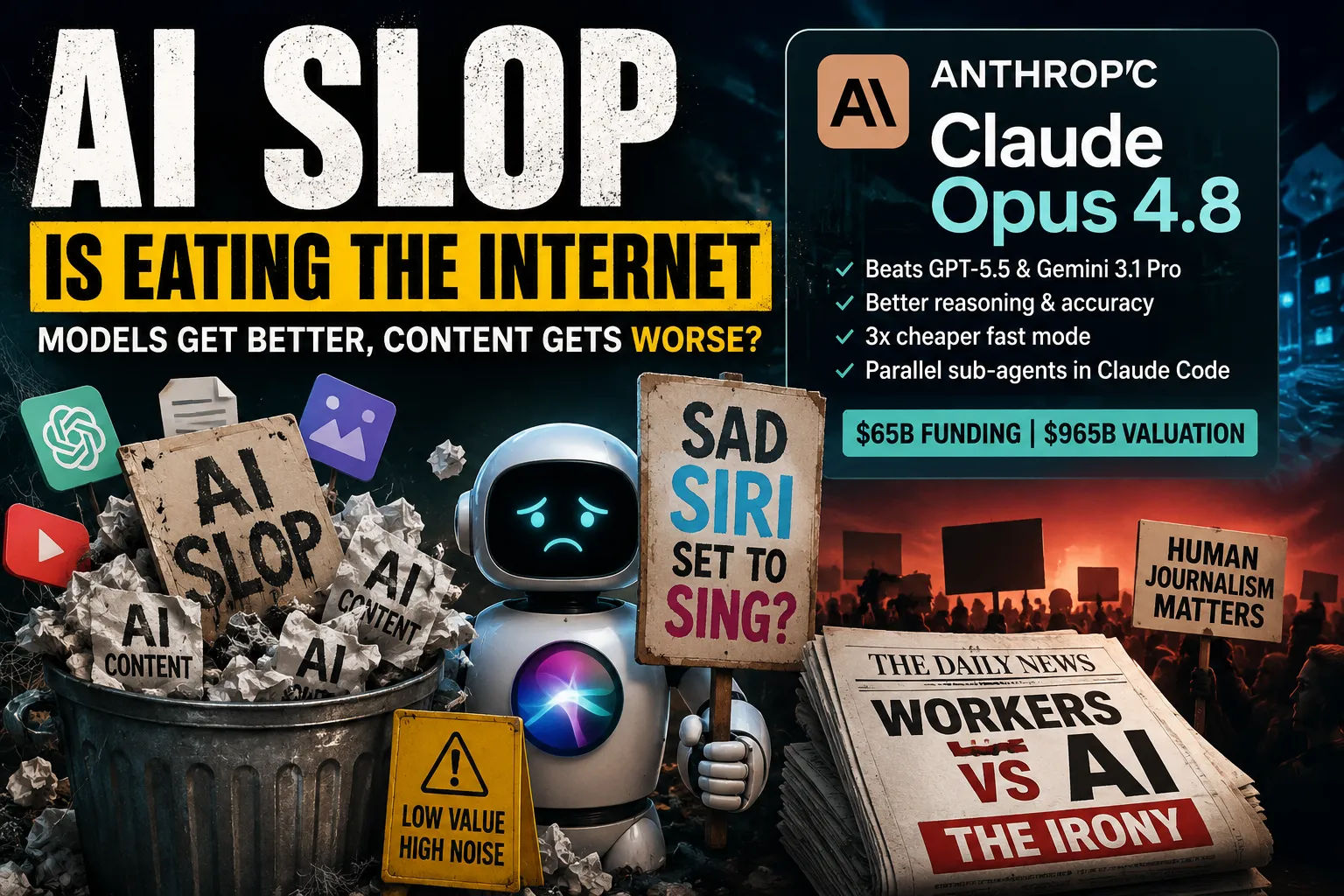
AI Slop Is Eating The Internet: Why Claude Opus 4.8, Siri's AI Troubles, and Media Industry Fights Matter
AI Slop Is Eating The Internet: Why Claude Opus 4.8, Siri's AI Troubles, and Media Industry Fights Matter
Remember when the internet felt human?
Blog posts were written by people who had actually used the products they reviewed. Tutorials came from developers who had solved the problem themselves. Travel guides were written by travelers, not algorithms.
Today, things are different.
Search for almost any topic and you'll find thousands of articles that look informative but feel strangely empty. The words are correct. The grammar is perfect. The structure is polished. Yet somehow the content says almost nothing.
Welcome to the era of AI Slop.
What Is AI Slop?
AI Slop refers to low-quality, mass-produced AI-generated content created primarily to attract clicks, rank in search engines, or generate ad revenue rather than provide genuine value.
It isn't necessarily wrong.
It isn't necessarily spam.
It's just content generated at such scale that originality, expertise, and authenticity become secondary concerns.
The internet is increasingly becoming an ecosystem where AI models are trained on content generated by previous AI models. The result is a feedback loop that gradually dilutes the quality of information available online.
Ironically, the biggest AI companies are facing the consequences of this problem themselves.
Anthropic Launches Claude Opus 4.8 Amid AI Arms Race
Anthropic has officially released Claude Opus 4.8, positioning it as a major leap forward in frontier AI models.
According to the company, Opus 4.8 outperforms GPT-5.5 and Gemini 3.1 Pro across several demanding categories, including:
- Agentic coding
- Computer use
- Financial analysis
- Humanity's Last Exam benchmark
The launch comes alongside reports that Anthropic is pursuing a massive funding round that could value the company at nearly $965 billion, potentially placing it ahead of OpenAI by valuation.
Why This Matters
Anthropic is no longer competing solely on AI safety messaging.
The company is now aggressively pursuing leadership in both performance and market valuation.
However, the timing also highlights a growing challenge within the AI industry.
Users want AI models that are:
- More capable
- More reliable
- Less expensive
- Faster
- Less prone to hallucinations
And they want all of those improvements immediately.
Key Highlights Of Claude Opus 4.8
- Pricing remains unchanged from Opus 4.7 at $5 input and $25 output per million tokens.
- Anthropic claims Opus 4.8 leads GPT-5.5 and Gemini 3.1 Pro on several major benchmarks.
- Improved uncertainty handling reduces unverified claims.
- Fast mode is reportedly three times cheaper.
- Claude Code now supports parallel sub-agents for complex tasks.
- The release arrived only 42 days after Opus 4.7.
- Anthropic has teased a future 'Mythos-class' AI model.
Agentic coding refers to AI systems that can plan, write, test, debug, and revise software through multiple steps instead of merely generating code snippets.
Siri's AI Problems Show That Building Great AI Is Hard
While companies like Anthropic race forward, Apple is facing a different reality.
Despite years of development and enormous resources, Siri's AI transformation has been slower than many expected.
The contrast highlights an important lesson:
Creating AI demos is easy. Creating AI products that reliably serve hundreds of millions of users is extraordinarily difficult.
Consumers often assume AI progress is linear. Industry insiders know that every improvement introduces new challenges involving accuracy, reliability, safety, and cost.
The Media Industry's AI Irony
Perhaps the most fascinating AI story isn't happening inside technology companies.
It's happening inside newsrooms.
Many media organizations are publicly criticizing AI systems for using journalistic content during training while simultaneously exploring their own AI-powered workflows.
Writers fear replacement.
Publishers want efficiency.
Readers want quality.
AI companies want training data.
Everyone depends on everyone else.
The situation perfectly captures the central contradiction of the AI era: organizations want the benefits of AI without necessarily accepting the consequences it creates.
The Bigger Problem: AI Training Data Is Running Out
Here's where AI Slop becomes more than just an annoying internet trend.
Modern AI systems need vast amounts of high-quality human-created content.
Much of the best public training data came from:
- Forums
- Blogs
- Books
- Research papers
- News articles
- Open-source projects
Most of that content was created before the AI boom.
As AI-generated content floods the web, future models increasingly encounter synthetic information instead of original human knowledge.
This creates a potential quality problem:
- AI learns from AI.
- Then future AI learns from that AI.
- And the cycle continues.
Many researchers believe this feedback loop could eventually reduce model quality if not carefully managed.
The Future: Better Models, More Noise
Claude Opus 4.8 demonstrates that frontier AI models continue to improve at an astonishing pace.
But better models alone won't solve the AI Slop problem.
The internet is entering a new phase where information abundance is no longer the challenge.
Information quality is.
The winners of the next decade may not be the companies that generate the most content.
They may be the people, publications, and platforms that can prove their content was created from genuine expertise, real-world experience, and original thinking.
In a world full of AI-generated noise, authenticity becomes a premium product.
And that may be the most valuable lesson from the rise of AI Slop.
Key Takeaway
Anthropic's Claude Opus 4.8 shows that AI models are becoming smarter and more capable every month. Yet at the same time, the internet is becoming increasingly crowded with AI-generated content, creating challenges for users seeking trustworthy information. The race is no longer just about building better AI—it is about preserving the quality of the human knowledge that AI depends on.
Get your FREE PDF on "100 Ways to Try ChatGPT Today"
Generating link, please wait for: 60 seconds
Post a comment
Comments
Join the conversation and share your thoughts! Leave the first comment.